speed.

independence.

reliability.

loading...

Muehlbauer History

The founder

Josef Mühlbauer, the son of a farmer from the ‘Steinpfalz’ region, gained his first entrepreneurial experience at an early age. At just eight years old, he was already dismantling tractors on his parents' farm in the Cham district.

As the eldest son, Josef was expected to take over the family farm and pursue a traditional career as a civil servant, teacher or even a priest. However, the demanding work on the farm sparked his passion for technology instead. He began an apprenticeship as a toolmaker at Vaillant in Roding, where he developed his technical skills. Over time, he realized that the role offered limited opportunities beyond manufacturing tools and on occasion, throwing knives for circuses.

After completing his apprenticeship and faced with the high unemployment rates of the time, Josef Mühlbauer moved to Munich in search of better career opportunities and a stronger industrial environment.

It all started with an idea...

1981

The beginnings in Roding

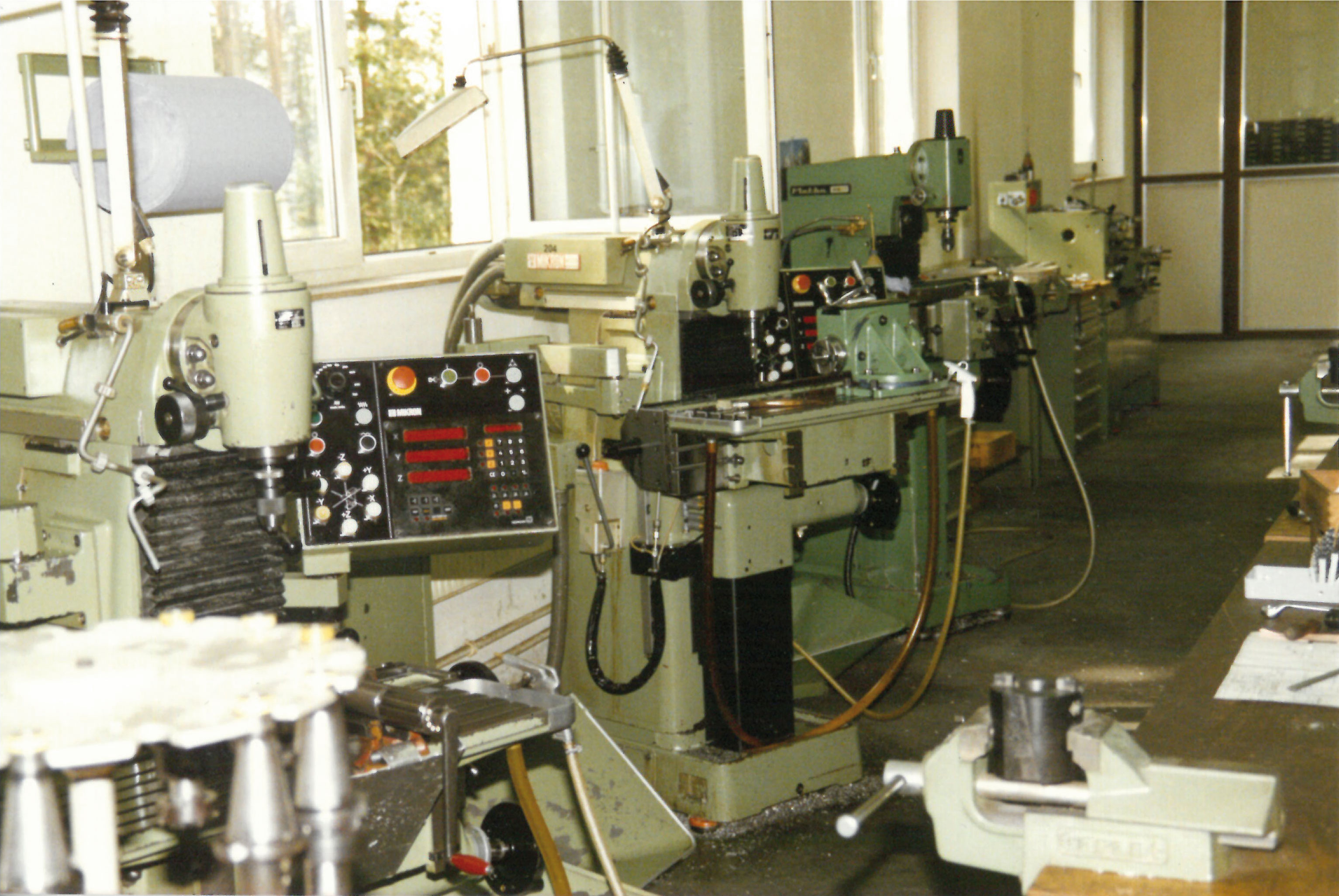
Back in Roding, company founder Josef Mühlbauer completed his first orders in an old shoe store on the banks of the Regen River. The machine he had purchased in Munich could only be transported into the building through one of its windows. Shortly afterwards, he hired his first employees, and the machines quickly reached full capacity, enabling the purchase of additional equipment.

Working days began early in the morning at the company and ended late in the evening at the construction site. Weekends were equally dedicated to building the new facility in Roding's industrial area. This is how the first building at today's company headquarters came into being. Using a low-loader provided by Feldbauer and plenty of manpower, all machines were transported to the new premises within a single day. Even during the relocation, the building continued to be expanded.

In autumn 1983, the relocation and expansion of the first building were completed. One year later, construction of the second building was finished. In total, Josef Mühlbauer invested around DM 1.5 billion in the construction of the new site.

1987

New horizons

In the early 1980s, the semiconductor industry began to grow rapidly, driven by increasing demand for mobile phones and computers. As one of the leading manufacturers of die bonders, Foton supplied major customers such as Motorola and IBM. Muehlbauer entered the market by manufacturing mechanical components for Foton's production equipment and providing regular maintenance services.

Like many emerging industries, the semiconductor sector experienced periods of rapid growth as well as significant challenges. One of these setbacks was Foton's insolvency. Recognizing the opportunity, Josef Mühlbauer acquired the company, taking over its production facilities and workforce.

Entering the semiconductor market marked a completely new chapter for the company. Together with a highly motivated team and a spirit of innovation, Josef Mühlbauer achieved a remarkable breakthrough. In November 1987, after he and his team of ten engineers had developed the M1, the world's fastest Die Bonder, he proudly declared, "Now we are world champions."

Presented at the Productronica trade fair later that year, the M1 achieved a peak output that doubled the throughput of competing machines. While developing a machine of this complexity typically took around two years, the team completed the project in just six months. The introduction of the M1 Die Bonder established the company as a leading player in the semiconductor industry and laid the foundation for its long term success.

1988

Right intuition

Towards the end of the 1980s, the German Federal Post Office began searching for suppliers to produce the first chip cards for use as telephone cards. By then, Josef Mühlbauer had already recognized the potential of this emerging market. He founded the subsidiary Eltech and established a card production facility on the company's former premises in Oberhaching. With the newly developed D9000 1 chip card IC module, he secured the company's first customer, Gesellschaft für Automation und Organisation (GAO), the research institution of banknote printer Giesecke+Devrient, which supplied prepaid telephone cards to the German Federal Post Office. This collaboration strengthened the company's position in the chip card industry and opened the door to a rapidly growing market.

Shortly afterwards, Muehlbauer began producing the German health insurance card, which was designed to replace traditional paper medical certificates. From then on, an insured person's data could be stored on a single chip. The company supplied customers with the production equipment needed to mill and personalize the chip cards. By the end of the 1980s, more than 80 percent of all German health insurance cards were produced using the Muehlbauer’s machines.

1995

The early days of RFID

By June 1995, the company had grown to 400 employees worldwide, with approximately 330 to 340 based in Roding. Around one quarter of the workforce was employed in research and development. With an average employee age of just 27, the company reflected a young and innovative culture. In response to the shortage of skilled workers, the company invested heavily in training its own specialists. At the time, around 50 apprentices were gaining practical experience as part of its growing workforce. Annual turnover had reached DM 70 million.

RFID technology also became an important area of focus. At the Semicon trade fair in Munich in 1995, sales representatives Thomas Betz and Heiner Brenninger held their first discussions with representatives of Texas Instruments, one of the world's leading semiconductor manufacturers. Texas Instruments was already producing transponders for car keys and animal identification. Betz and Brenninger proposed manufacturing the transponders in label format for product identification, an idea that laid the foundation for the company's first RFID project.

As a result, the company was commissioned to build label production machines for the Texas Instruments subsidiary in Freising, Upper Bavaria. Preparations began immediately, and the first Tag Assembly Line (TAL) featuring pick and place technology was developed specifically for the project.

1996

Growth

In 1996, the company's headquarters in Roding underwent a major expansion. A representative administrative building and five large interconnected production halls were constructed in the newly developed section of the Roding industrial area. The previously limited assembly space was expanded by around 11,000 square metres, significantly increasing production capacity. To support the new facilities, around 100 kilometres of cable were installed for 50 additional workstations and 1,100 new ports.

At the time, the company employed around 600 people in Germany, with a further 50 employees working at international locations. Growth was also reflected in vocational training, as 37 new apprentices began their careers across seven different professions. From industrial mechanics and industrial electronics technicians to technical illustrators and office clerks, the company offered a broad range of opportunities for young people entering the workforce.

The rapid development attracted regional attention. The Chamer Zeitung headlined: "Annual sales likely to reach the 100 million mark this year."

1998

On the trading floor

One of the most significant and ambitious milestones in Muehlbauer's history came on July 7, 1998, when Muehlbauer was listed on the Frankfurt Stock Exchange. Demand for the shares was exceptionally strong, with the offering already heavily oversubscribed four days before the initial public offering.

The shares were issued at a price of DM 96 and rose by around 30 percent on the first day of trading, closing at approximately DM 120 to DM 125 per share. Although the initial price increase was modest compared with some other public offerings of the time, it reflected investors' confidence in Muehlbauer's long term potential rather than short term speculation.

Josef Mühlbauer was pleased that the bold decision to go public had paid off. The listing quickly generated widespread attention, particularly in the Cham district, where Muehlbauer's stock became a source of local pride. At the time, it was highly unusual for a publicly listed company to originate from such a rural region.

2000

True invention

At the beginning of the 2000s, Muehlbauer's engineers pursued a clear objective: making production faster and more precise. Together with Josef Mühlbauer, the team developed a groundbreaking technology known as Direct Die Attach (DDA).

Unlike conventional flip chip technology, the DDA process required only a single needle to handle each chip. The wafer was turned over, allowing the needle to pick up the chip and place it directly onto the antenna. By eliminating the need for a second handling step, DDA technology achieved significantly higher throughput while improving placement accuracy.

In 2003, Muehlbauer filed patents for the DDA technology. However, the market was not yet ready for the innovation. It was not until 2014 that the technology gained widespread acceptance and the first DDA machines were purchased.

2001

Awards

In the early 2000s, Muehlbauer received several prestigious awards in recognition of its entrepreneurial success and continued growth. During a ceremony in Regensburg in the summer of 2002, company founder Josef Mühlbauer was awarded the Federal Cross of Merit for his outstanding achievements.

In 2003, Muehlbauer was named one of "Bavaria's Best 50," an award presented annually by the Bavarian Ministry of Economic Affairs to the state's most successful medium sized companies. The award recognized outstanding entrepreneurial performance, particularly sustained revenue growth, job creation, and commitment to vocational training.

The recognition was further highlighted by a visit from the then Bavarian Minister of the Interior, Dr. Günther Beckstein, who toured Muehlbauer's headquarters in Roding to learn more about the company's latest security technologies and innovations.

2003

New Positioning

In December 2003, Muehlbauer received a draft contract from the National Bank of Serbia. Just four years had passed since the Kosovo conflict and the NATO bombing campaign, making Serbia an unusual business partner at the time. Following extensive discussions that fostered mutual trust, Muehlbauer accepted the project and signed a contract with the National Bank of Serbia, which had been commissioned by the Serbian Ministry of the Interior to establish a complete production line for national ID cards.

The project marked a major milestone for Muehlbauer. For the first time, the company was entrusted not only with supplying the production equipment but also with providing the associated services. Despite political changes and the challenges they brought, the partnership remained strong. Production of Serbian ID cards began in 2007, with approximately 4.5 million cards produced.

Shortly afterwards, the National Bank of Serbia launched a tender for the production of electronic passports. Under President Boris Tadić, Serbia sought closer integration with the European Union, including visa free travel for Serbian citizens within the Schengen Area. One of the key requirements was the introduction of passports that met European Union standards.

The required production equipment was manufactured at Muehlbauer's facility in Malaysia. The successful implementation of the project enabled Serbia to introduce its new passports, and from December 2009 Serbian citizens were granted visa free travel for short stays within the Schengen Area. For Muehlbauer, the project became an important reference and opened the door to further international business opportunities.

Building on this successful partnership, Muehlbauer decided to establish its own production site in Stara Pazova, near Belgrade. Construction began in October 2011, and manufacturing of smart products and system solutions commenced in spring 2012 with an initial workforce of 100 employees.
2007

Expansion to Asia

In 2007, Muehlbauer expanded to Malaysia to strengthen its presence in the Asian market while increasing production capacity. The new production site in Melaka was established to complement the company's existing facilities in Germany. At its opening, around 60 highly qualified employees joined the site across research, development, assembly, service, and sales.

Today, Muehlbauer Melaka employs around 250 people and continues to provide opportunities for apprentices and young professionals to participate in exchange programs with the German headquarters.

The Melaka facility develops and manufactures specialized equipment for the semiconductor industry, while also adapting solutions to meet individual customer requirements. From this strategically located site, Muehlbauer supplies customers throughout Asia with high quality carrier tapes and advanced manufacturing solutions. Since operations began, the facility has established numerous long term partnerships and successfully delivered a wide range of international projects.

2007

Location Nitra

In 2007, Muehlbauer Technologies s.r.o. was founded in Nitra, Slovakia, with an initial workforce of 15 employees. Since then, the site has grown significantly. Today, around 570 employees work in the PARTS & SYSTEMS and AUTOMATION business divisions and the workforce continues to expand. More than €30 million has been invested in the site through two major expansion phases.

Through close cooperation with five secondary schools in the Nitra region, three Slovak universities, and Deggendorf Institute of Technology, Muehlbauer Technologies s.r.o. has become a national leader in dual vocational education and training.

The site's growth continued in 2018 with the establishment of Muehlbauer Automation, completing the organizational separation of the MPS and AUTOMATION business divisions. Between 2019 and 2022, a further €12 million was invested in the Slovakian site, alongside plans to create an additional 100 jobs.

2008

Flexible Thin Solar

In 2008, solar energy was still an emerging field with significant potential for technological development. Recognizing the opportunities early, Muehlbauer invested extensively in research and development to support the growing solar industry. The company supplied both the reel to reel production equipment required for back end manufacturing processes and the expertise needed to produce solar products such as solar cells and solar panels.

These technologies opened opportunities in new application areas, including building integrated photovoltaics (BIPV), outdoor products, public transport and other emerging markets. Muehlbauer's first product for the solar industry was a laboratory system, followed by four additional production systems.

Although the company demonstrated its technological capabilities in the sector, solar technology had not yet reached the level of market maturity required for widespread commercial adoption. As a result, the business did not develop into a sustainable market at that time.

2009

Government solutions

In 2009, Muehlbauer was awarded a major identity project by the Ministry of the Interior of the Republic of the Congo. The project involved the development and implementation of a customized infrastructure for issuing highly secure identity documents. Designed as a comprehensive national identity solution, the system covered a wide range of document types and was built on the country's existing database, which formed the foundation for a nationwide citizen registry.

The project began with extensive consulting and the design of the overall system architecture, including the deployment of 800 decentralized mobile enrollment units. Data was collected and processed at 105 decentralized DEOS sites before being transferred to and managed within the central SDM database. Highly secure blank documents, produced by Muehlbauer in Germany, were personalized at three facilities in Brazzaville, Oyo and Pointe Noire before being distributed to decentralized issuance centers.

In addition, 33 embassies around the world were equipped with systems for the enrollment, personalization, and issuance of visas, emergency passports, and consular cards. The project also included a police card solution comprising the complete hardware and software infrastructure for registration and issuance at five decentralized offices, together with a central database and document personalization center in Brazzaville.

The same year, Muehlbauer successfully completed its first passport project for the Republic of Tajikistan. A total of 100,000 passports were produced, with the passport prototype designed in Roding. Muehlbauer also manufactured and personalized the passport data pages, marking another important milestone in the company's identity solutions business.

2012

Security Summit

"We dare to do what we have never done before." With these words, company founder Josef Muehlbauer launched the first Security Summit in Roding in 2012, a multi day international conference dedicated to security and identity solutions. The event brought together ministers, state secretaries, consuls, ambassadors, and security experts from more than 30 countries to gain insight into Muehlbauer's latest innovations in secure document and identity technologies.

One of the highlights of the event was the presentation of the company's Complete Government Solution, including integrated border control systems and equipment. Muehlbauer was the first company in the world to introduce such a comprehensive solution, combining multiple technologies into a single platform.

Alongside the conference program, participants experienced Bavarian culture through a range of accompanying events and activities. Following the success of the inaugural summit, the Security Summit returned in 2014, this time hosted at the newly opened TECURITY® Center at Muehlbauer's headquarters in Roding.

2015

A turbulent year

In 2015, Mühlbauer Traceability GmbH in Ehingen, near Ulm, was closed after the site was no longer economically viable. Although the closure affected more than 50 employees, including four apprentices, it had no significant impact on the Muehlbauer Group as a whole. The apprentices were able to successfully complete their vocational training despite the site's closure.

At the same time, Muehlbauer continued to pursue its international growth strategy. Building on the establishment of technology sites in Nitra (Slovakia), Newport News (USA) and Melaka, (Malaysia), in 2009, the company further strengthened its presence in Asia with the opening of a new 11,000 square metre production facility in Wuxi (China) at the end of 2014.

The Wuxi site became an important hub for Muehlbauer's activities in Asia, promoting collaboration between Germany and China in the fields of semiconductors, Smart Identification, and Flexible Solar Technology. In addition to expanding local engineering support, production capacity, and technical training capabilities, the facility also provided space for a substantially larger spare parts warehouse.

2018

Record project

Mozambique's journey from paper documents to eVisa: On the African continent, Muehlbauer not only expanded its leadership in the Government Solutions sector but also achieved a new milestone in the company's history with a project valued at US$100 million. The public private partnership project in Mozambique included the provision, distribution, installation, and commissioning of a state of the art system for issuing multiple types of secure identity documents to the country's citizens and visitors.

To deliver the project within an ambitious timeframe and in close cooperation with local partners, Muehlbauer established its own business location in the capital, Maputo. Staffed by around 60 employees, the site was responsible for contract execution, ongoing technical support, and customer training. More than 800 government employees were trained to operate and maintain the highly sophisticated systems. The complete solution was delivered in just six months and became fully operational only 12 months after the contract was signed.

To further enhance the services provided, the Government of Mozambique expanded the solution to include an electronic visa platform. The eVisa project officially started in September 2018 and was planned as an eight year initiative, further advancing the country's digital identity and border management infrastructure.

2018

Getting ready for future

In 2018, Muehlbauer expanded its facility in Newport News, Virginia, which had served as the company's base for North American operations since 1992. Following the opening of its first demonstration room in 2009, a new 51,200 square foot building was completed in December 2017. The expansion included a modern showroom for product demonstrations and training, as well as additional assembly capacity. The project represented an investment of US$12 million and created 20 new jobs.

With the opening of the Smart Factory Competence Center, Muehlbauer established a unique exhibition and demonstration facility for the North American market. The center enabled the company to showcase its expertise in card personalization, laser engraving, and advanced manufacturing technologies directly to customers and partners.

The site's growth continued in the years that followed. In May 2022, Virginia Governor Glenn Youngkin announced that Muehlbauer would invest a further US$9 million to expand its Newport News operations. The investment included upgrades to the facility in Oakland Industrial Park and the installation of additional production equipment to further increase manufacturing capacity.

2019

Moving forward

In 2019, a devastating fire severely damaged the MB Electroplating Hall. Rather than simply replacing the facility, Muehlbauer took the opportunity to rebuild, refurbish, expand, and modernize the site through a major investment of €25,000.

Two years later, the Muehlbauer Precision Parts and Systems facility had been transformed into one of the most advanced electroplating plants in Europe, setting new standards in technology, efficiency and production quality.

In 2021, Muehlbauer also celebrated its 40th anniversary. By then, the Muehlbauer Group had established a strong global presence and was well positioned for the future, continuing its commitment to innovation, technological excellence, and outstanding quality.

2022

Into the future

eMobility represents clean and efficient transportation powered by battery electric and hydrogen fuel cell technologies. Muehlbauer sees eMobility as an important contribution to global decarbonization efforts and supports the growth of these technologies by providing state of the art production systems and turnkey assembly solutions for fuel cells, battery cells, and battery management systems for the automotive industry. Through these innovations, Muehlbauer contributes to the development of sustainable mobility solutions for the future.

To meet the growing demand for advanced manufacturing technologies, the company's major production site in Nitra, Slovakia, continues to be expanded in line with the vision of a sustainable smart factory.

Looking ahead, eMobility, fuel cell technology, and battery manufacturing will play a decisive role in the global transition to sustainable energy. Muehlbauer continues to invest in these rapidly growing markets while expanding its capabilities to support the production of next generation energy solutions. As demand for energy efficient battery cell factories continues to increase worldwide, the company is further strengthening its resources at its Slovakian production site. There, one of the most modern and efficient manufacturing facilities for regenerative energy technologies in the automotive industry is being developed. Through continuous research and development, Muehlbauer remains committed to creating innovative solutions that promote greater sustainability, not only for the automotive industry but across a wide range of future technologies.

2025

Another milestone

In 2025, Muehlbauer celebrated the grand opening of its new Automation Innovation Center in Stara Pazova, Serbia.

Among the distinguished guests was President Aleksandar Vučić, whose presence underscored the significance of this milestone for both the company and the region.

The Automation Innovation Center represents Muehlbauer's commitment to innovation, collaboration, and technological progress. As a hub for developing and advancing cutting edge automation solutions, the new facility strengthens the company's capabilities and supports future growth in automation technologies.